Every loom in the shed has a speed set on it, yet two looms on the same quality can give very different metres by the end of a shift. The gap is time the loom stood still: a broken thread, a beam change, a power cut, a weaver busy at the next machine. A loom efficiency calculation puts a number on that gap, loom by loom, so you know where cloth and money are being lost.
This post explains what loom efficiency means for a Surat waterjet or airjet unit, gives the formula with an illustrative example, lists the usual reasons it drops, and shows how to track it per loom and per shift without a separate register. All numbers below are illustrative, chosen to keep the arithmetic clear.
What loom efficiency means
Two terms first. A pick is one weft thread (vana) laid across the warp threads (tana). RPM is the loom’s speed in revolutions per minute; on these looms each revolution inserts one pick, so RPM is the number of picks the loom inserts in a minute while it is running.
Loom efficiency is the share of the shift the loom actually spent weaving, measured as picks: the picks it really wove, divided by the picks it could have woven if it had run at its RPM for the whole shift. A loom that never stopped would be at 100%. Every stop, however short, pulls the number down.
The loom efficiency calculation formula
- Possible picks = RPM × shift hours × 60
- Actual picks = the reading on the loom’s pick counter, or metres woven × picks per inch (PPI) × 39.37
- Efficiency % = actual picks ÷ possible picks × 100
The 39.37 converts inches to metres: a quality with 50 PPI has 50 × 39.37 = 1,968.5 picks in every metre of cloth. Put together, the formula a munim (the office accountant) can keep in a spreadsheet is:
Efficiency % = metres × PPI × 39.37 × 100 ÷ (RPM × hours × 60)
An illustrative example
Take a loom running at 600 RPM through a 12-hour shift, weaving a quality with 50 PPI. The day’s takas (cut pieces of grey cloth, unfinished fabric taken off the loom) add up to 175 metres for that loom.
- Possible picks: 600 × 12 × 60 = 4,32,000.
- Actual picks: 175 × 50 × 39.37 = 3,44,488 (rounded).
- Efficiency: 3,44,488 ÷ 4,32,000 × 100 = about 79.7%.
Turned around, the same loom at 100% would have woven 4,32,000 ÷ 1,968.5, or about 219.5 metres. The difference of roughly 44 metres is what the stops cost in that one shift. Multiply that by the number of looms and shifts in a month and the reason to track it is plain.
Two habits keep the number honest. Use the same shift length for every loom, whether or not you count meal breaks, so looms can be compared fairly. And keep each loom’s RPM up to date: if a loom has been slowed down for a delicate quality but the record still shows the old speed, its efficiency will look worse than it is.
What pulls loom efficiency down
The causes are familiar to anyone who has stood on a weaving floor. In general terms:
- Warp breaks — a broken tana thread stops the loom until someone mends it. Weak yarn or poor sizing on the beam makes breaks more frequent.
- Weft stops — a missed or broken pick, or a problem with the weft yarn.
- Beam changes — bhidan, or beam loading (putting a fresh beam, the roller of warp threads, on the loom), and the drawing-in or knotting that goes with a new beam. The loom weaves nothing until the new beam is running.
- Waiting for a beam — the old beam ran out and the next one was not ready. Unlike a beam change, this time is avoidable.
- Power cuts — and the restart time after them.
- Breakdowns and maintenance — and, depending on the loom, trouble with the water supply on a waterjet or the air supply on an airjet.
- Weaver attention — when one weaver minds several looms, a stopped loom waits until someone reaches it.
Track efficiency per loom and per shift
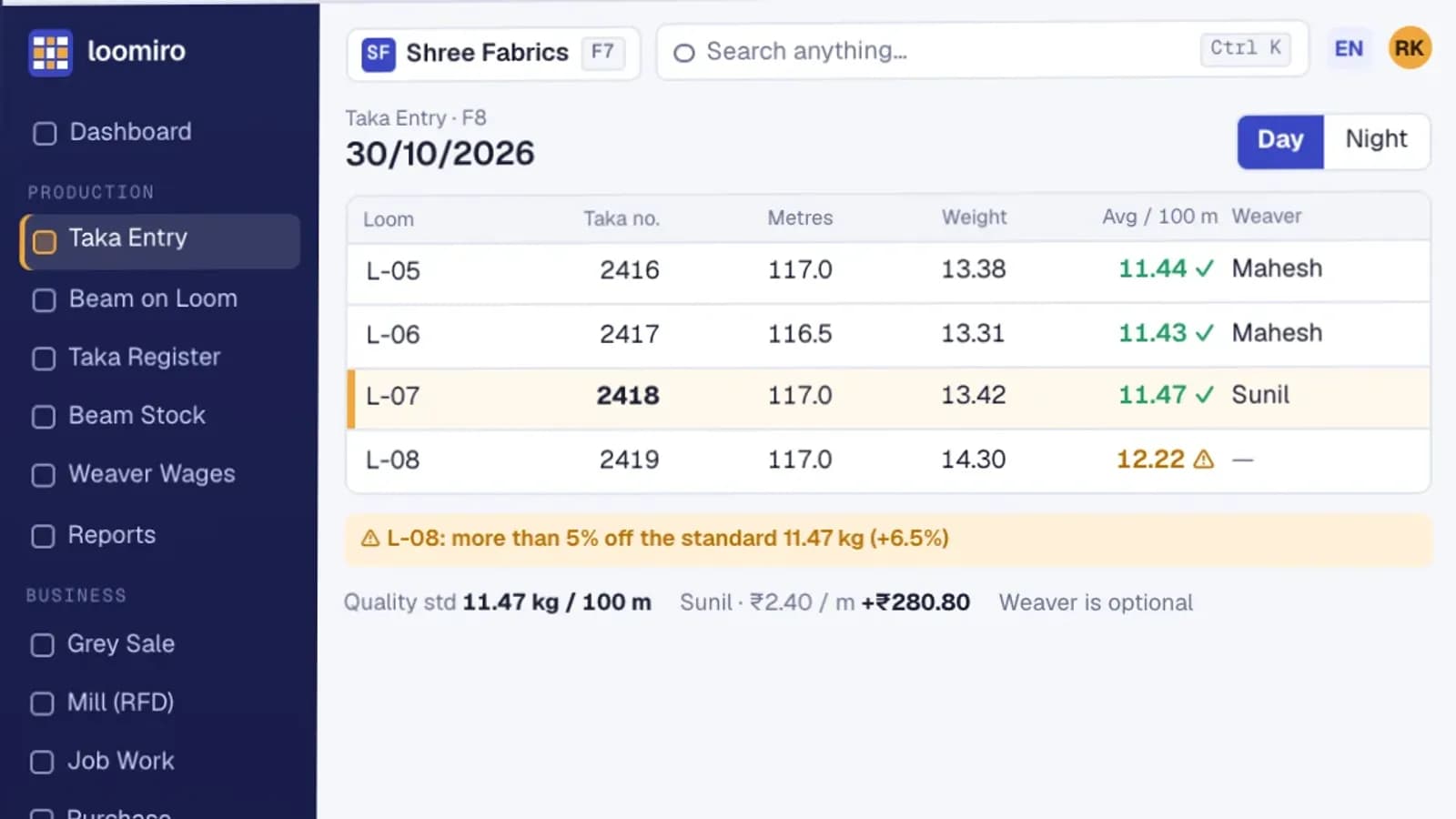
A unit-wide average hides the problem. Ten looms running well can cover two that are struggling, so record efficiency for each loom, separately for the day and night shift. The inputs are things you already write down: the loom, the quality (for its PPI), the loom’s RPM and the metres in each taka.
Then look at a few things each week:
- Which looms sit below the others on the same quality.
- Whether one shift is consistently lower than the other.
- Whether a loom’s efficiency dropped suddenly, which usually points to a mechanical fault or a bad beam rather than people.
For the worst few looms, ask the supervisor to note stop reasons for a week. That turns a number into a list of things to fix.
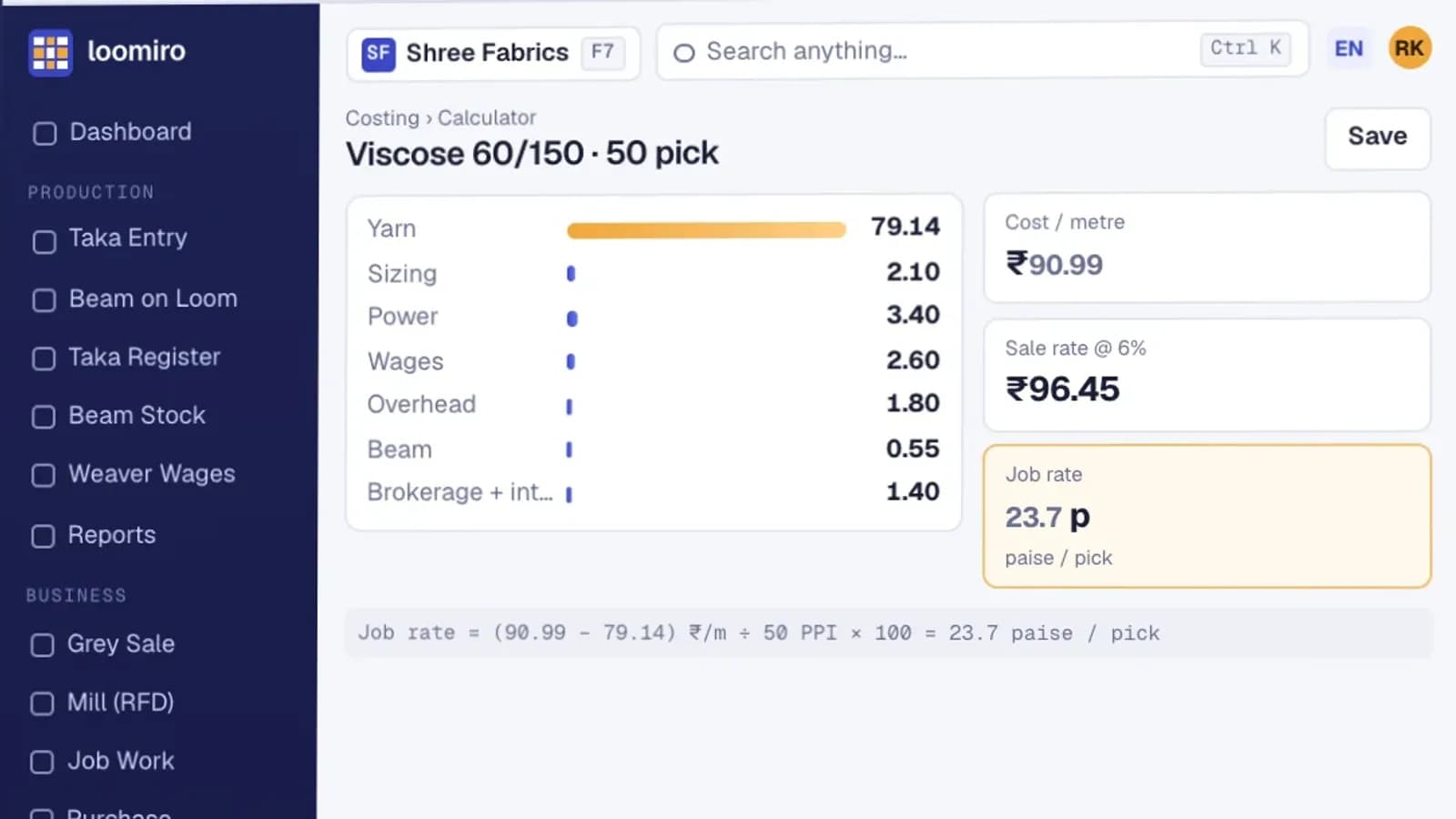
Efficiency also feeds your costing. Power, wages and overheads per metre depend on how many metres each loom actually weaves, so a rate quoted on an efficiency the floor does not reach will be too low.
How Loomiro calculates loom efficiency
Loomiro is the weaving unit software that DCPL Technology builds and runs for waterjet and airjet units in Surat. Each loom has its own master entry, and its efficiency comes from RPM × shift hours against the picks actually woven — the same method as above, worked out from the taka entries rather than typed separately.mdash; the same method as above.
Takas are entered for the day or night shift from the office keyboard or a phone on the floor, even without internet. Each loom’s page then shows its 30-day efficiency and a chart of daily metres, so a loom that is falling behind is visible at a glance. On the dashboard, a list of beams about to finish helps the floor get the next beam ready in time, which addresses the “waiting for a beam” loss directly. The production features page has the detail.
If you want to try the sum first, Loomiro’s free tools include a loom efficiency calculator that works out a loom’s efficiency from metres woven, picks, RPM and hours, with no login. For the full module list, see the Loomiro product page, and for the wider question of what a weaving unit needs from its software, read software for a weaving unit.
Is loom efficiency the same as loom production?
No. Production is the output — metres or picks woven in a shift. Efficiency is the percentage of the possible picks the loom actually wove. Two looms at the same efficiency can give different metres if their RPM or the quality’s PPI differ, so compare efficiency, not metres, when looms run different qualities.
If your unit already records takas but the efficiency picture still lives in someone’s head, start with the formula above for your five busiest looms this week. And if you need production tracking built around how your floor works, DCPL builds software for manufacturing units — talk to us about what you track today.