
A party calls and asks for a rate per metre on a new quality. If the answer comes from memory, or from last season’s rate, a move in yarn prices or a heavier weft can quietly turn the order into a loss. A proper fabric cost per meter calculation takes a few minutes and tells you the rate below which you should not go.
This guide walks through costing one metre of grey cloth — fabric straight off the loom, before dyeing or finishing — the way a Surat waterjet or airjet unit would: yarn weight from denier, yarn cost, then sizing, power, wages, overheads and brokerage, and finally a sale rate and a job rate in paise per pick. Every number in the worked example is illustrative, chosen to keep the arithmetic easy to follow. Use your own figures.
What goes into the cost of one metre
Two kinds of cost add up to the cost of a metre:
- Yarn — the warp, or tana (threads running along the length, wound on the beam, the large roller that feeds the loom), and the weft, or vana (threads laid across the cloth, one pick at a time).
- Conversion — everything it takes to turn that yarn into cloth: sizing (the starch-like coating put on warp yarn so it survives weaving), power, weaver wages, beam charges, overheads, and brokerage and interest on the sale.
Step 1: warp (tana) weight per metre
Denier is the weight in grams of 9,000 metres of yarn. So one metre of a single thread weighs denier ÷ 9,000 grams, and the warp in one metre of cloth weighs:
Warp kg per metre = ends × denier ÷ 90,00,000
Ends are the number of warp threads across the beam. The 90 lakh comes from 9,000 metres × 1,000 grams per kilo. The same formula gives a whole beam’s weight if you multiply by the beam’s metres.
Illustrative example: 9,000 ends of 50 denier: 9,000 × 50 ÷ 90,00,000 = 0.050 kg, or 50 grams of warp per metre.
Step 2: weft (vana) weight per metre
Picks per inch (PPI) is how many weft threads are laid in each inch of cloth. One metre of cloth holds PPI × 39.37 picks, and each pick is as long as the reed width. When the reed width is in inches, the 39.37 and the inch-to-metre conversion cancel out, which gives a tidy formula:
Weft kg per metre = PPI × reed width (inches) × denier ÷ 90,00,000
Illustrative example: 50 PPI, 60-inch reed width, 75 denier weft: 50 × 60 = 3,000 metres of weft per metre of cloth; 3,000 × 75 ÷ 90,00,000 = 0.025 kg, or 25 grams.
If you buy yarn by count rather than denier, convert to denier first, or keep the whole costing in one unit.
Step 3: yarn cost per metre
Multiply each weight by its latest purchase rate per kilo.
- Warp: 0.050 kg × ₹200 per kg = ₹10.00
- Weft: 0.025 kg × ₹160 per kg = ₹4.00
- Yarn before allowance: ₹14.00
Warp threads bend over and under the weft (crimp), so the beam uses more yarn than the cloth’s length, and some yarn is wasted at every beam change. Add an allowance from your own records. In this example we add 5%, which brings yarn to ₹14.70 per metre. All rates here are illustrative.
Step 4: conversion costs per metre
Bring each running cost down to rupees per metre:
- Sizing — the sizing charge for the beam ÷ metres the beam will weave.
- Power — loom kW × hours × rate per unit ÷ metres woven in those hours.
- Wages — a per-metre rate as it is; a per-lakh-picks rate converted using picks per metre (PPI × 39.37).
- Beam charges — warping, drawing-in and spreader charges ÷ metres per beam.
- Overheads — rent, maintenance, office salaries and the rest of the month’s fixed costs ÷ the month’s metres.
- Brokerage and interest — the broker’s commission, plus the cost of waiting for payment on credit.
Power, wages and overheads per metre all depend on how many metres the loom actually weaves, so a costing that assumes a higher loom efficiency than you achieve will look better than reality.
Illustrative figures: sizing ₹0.80, power ₹1.50, wages ₹1.20, beam charges ₹0.30, overheads ₹0.90, brokerage and interest ₹0.60. Conversion total: ₹5.30.
Cost per metre = ₹14.70 yarn + ₹5.30 conversion = ₹20.00
Step 5: sale rate and job rate in paise per pick
For your own grey sale, add your margin to the cost. With an illustrative 6% added on cost: ₹20.00 × 1.06 = ₹21.20 per metre.
On job work, the party sends its own beam and weft yarn, so you are paid only for conversion. Surat units quote this in paise per pick:
Job rate (paise per pick) = conversion cost per metre ÷ PPI × 100
In the example: ₹5.30 ÷ 50 × 100 = 10.6 paise per pick. That is your break-even on conversion; remove any cost the party bears (for example sizing, if its beam arrives sized) and add your margin before quoting.
Weight is the other half of the check. The example’s 75 grams of yarn per metre means about 7.5 kg per 100 metres before allowances; to compare that with a weighed taka (a cut piece of cloth off the loom), see how to calculate fabric GSM and taka weight.
Where fabric costings usually go wrong
- Using an old yarn rate after prices have moved.
- Leaving out crimp and wastage.
- Assuming a loom efficiency the floor does not deliver.
- Forgetting brokerage and the interest cost of 30 or 60 days’ credit.
- Quoting on grey metres for cloth sold after the mill: when goods go to the process house and come back as RFD (ready for dyeing) or finished cloth, shrinkage means fewer metres to sell.
Costing in Loomiro
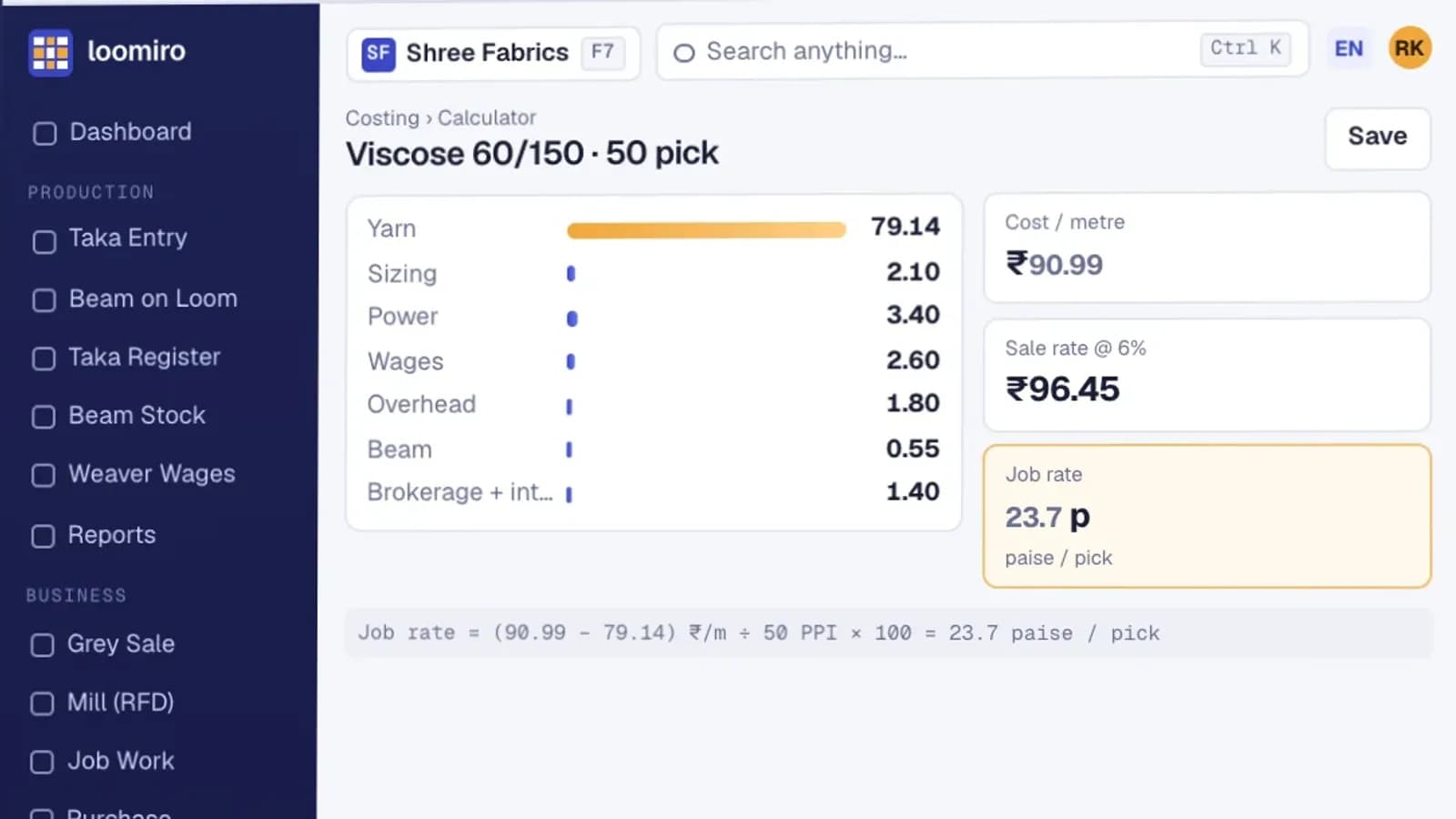
Loomiro, the weaving unit software that DCPL Technology builds and runs, has a free Fabric Costing calculator that needs no login and works out the yarn cost of a beam and of one metre of cloth, by denier or count.
Inside the app, the costing module fills in the reed, picks, width, ends, denier and last yarn purchase rate when you pick a quality. It gives a breakdown of yarn, sizing, power, wages, overhead, beam, and brokerage plus interest, then the sale rate at your margin and the job rate in paise per pick. A what-if table shows how the cost moves if the yarn rate or efficiency changes, and actual production can be checked against the plan. The example screen on loomiro.com shows a viscose quality at 50 picks costing ₹90.99 a metre, of which yarn is ₹79.14, giving (90.99 − 79.14) ÷ 50 × 100 = 23.7 paise per pick. The Loomiro product page lists the other modules.
How do I convert paise per pick into a rate per metre?
Multiply the paise per pick by the picks per inch and divide by 100. At 10.6 paise per pick and 50 PPI, that is 10.6 × 50 ÷ 100 = ₹5.30 per metre, which is the same conversion cost you started from.
If your unit costs in Excel today and you want quotes, purchase rates and production in one place, DCPL builds software for manufacturing businesses as well as running Loomiro. Send us your current costing sheet and we will tell you what can be automated.