
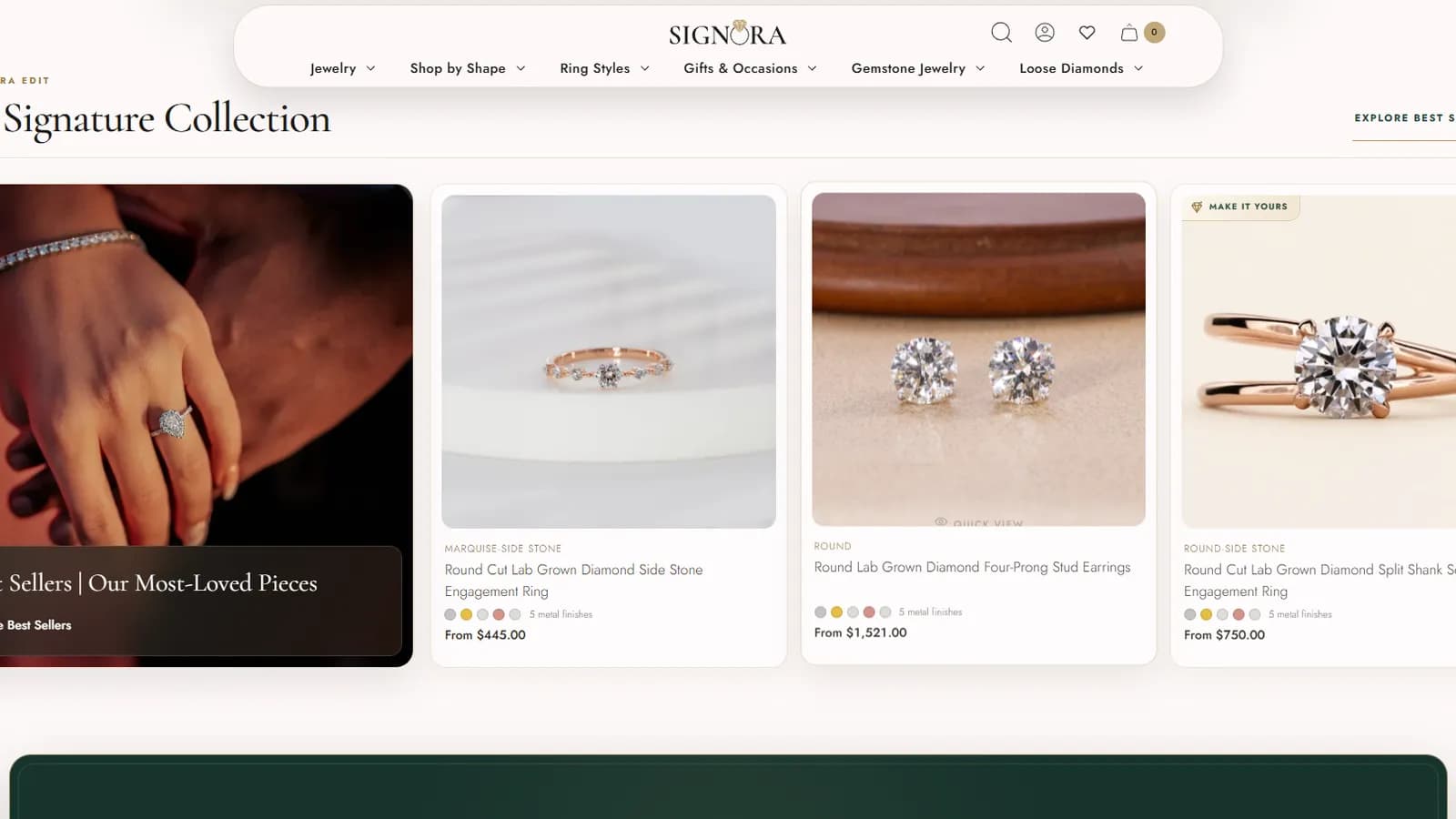
Picking a beautiful theme is the easy part of launching a Shopify jewellery store. The hard part sits underneath: one ring design that comes in two metals, three purities and a dozen sizes, prices that move with the daily gold rate, certificates that buyers want to see before they pay, and a checkout that has to feel safe for a high-value order.
Jewellers who skip this groundwork usually discover it after launch, when a product cannot hold all its options, a price goes out of date overnight, or shoppers ask on WhatsApp for the certificate they could not find on the page. This guide covers the technical setup that needs deciding before you upload your first product.
Plan your Shopify jewellery store’s product structure first
In Shopify, a product is the design and a variant is a specific buyable version of it: 18K yellow gold, size 12, for example. Every option you add (metal, purity, colour, ring size, centre-stone size, chain length) multiplies the number of variants.
Start by listing, for each product type, which options genuinely change the price or the item you dispatch. Metal and purity always do. Ring size often does, because a larger size uses more metal. Engraving text does not create a different item and should not be a variant at all; it belongs in a custom field the customer fills in.
Write this down as a simple matrix per category — rings, earrings, pendants, chains — before anyone touches the theme. It decides how your catalogue, filters, pricing and inventory will work for years.
Working within Shopify’s variant limits
Shopify limits how many options and variants a single product can have, and those limits have changed over time, so check the current numbers in Shopify’s help centre on variants rather than relying on an old blog post. A fully configurable ring can hit the ceiling quickly once metal, purity, size and stone size are multiplied together.
There are three common ways to handle it:
- Split by a major option. List the platinum version and the gold versions as separate products, linked to each other on the page so shoppers can switch.
- Keep only price-changing options as variants. Capture the rest, such as engraving or gift packaging, as custom fields attached to the order.
- Use a configurator for made-to-order pieces. For Signora Jewels, we built an interactive customiser that lets buyers choose the metal (14K or 18K solid gold, or platinum), diamond carat size, stone shape and ring size for made-to-order designs.
Pricing that follows the metal rate
A gold price set on Monday is wrong by Tuesday. On a store with a few designs, someone can update prices by hand. On a catalogue where each design has many variants, manual updating is slow and one wrong cell can publish a price below cost.
The fix is to store the inputs — metal weight, purity, making charge, stone cost — against each variant and calculate the price from the day’s rate. MetalIQ, a Shopify app we build and operate, does this for existing Shopify variants: you enter the daily metal rate once, it recalculates metal, centre-stone-size and chain-length variants, shows the proposed prices for review before anything reaches the store, holds unusually large changes and can undo a completed run. Note that it prices the variants you already have; it does not create product options.
Loose diamonds and gemstones are a catalogue problem
If you also sell loose stones, you are dealing with a different shape of data: hundreds or thousands of individual stones, each with its own shape, carat, colour, clarity, cut and certificate, often arriving as a supplier spreadsheet that changes every week.
Creating each stone by hand does not scale. FacetFlow, our Shopify catalogue app, reads a jeweller’s supplier file or feed, maps the stone data, applies the merchant’s own markup rules and publishes a filterable diamond and gemstone catalogue on the merchant’s own Shopify storefront. The supplier’s wholesale cost is used to calculate the retail price but is kept out of the storefront.
Show certificates and hallmarks where buyers decide
For an expensive purchase, the certificate is part of the product. Do not bury it in a footer page.
- Certificate details on the product page. Show the grading laboratory, certificate number and key grades next to the price, with a link to view the certificate itself.
- Hallmarking for gold. Indian buyers look for BIS hallmarking and the HUID on gold jewellery. Say clearly which pieces are hallmarked and how the buyer can verify it.
- Lab-grown or natural, stated plainly. If you sell both, label every product and make it a filter. Ambiguity here costs trust quickly.
- Structured data, not just text. Store certificate number, lab and grades in Shopify metafields so they can feed filters, product pages and comparison views consistently.
Stores we have built for brands such as Aarinya Gems present IGI or SGL certified lab-grown diamond jewellery and BIS-hallmarked gold, so the certification sits with the product rather than on a separate page.
Photography and video that answer questions
Jewellery photographs are not decoration; they are how the buyer inspects the piece. Plan a consistent shot list for every product: a clean front view, a side view showing depth and setting, an on-hand or on-neck shot for scale, and a close-up of the stone. A short video shows sparkle and movement in a way no still image can.
Keep the background and lighting consistent so the catalogue looks like one collection. And compress images properly: large, slow-loading galleries frustrate shoppers browsing on their phones over mobile data.
Building trust into a high-value checkout
A buyer about to pay a large amount to a store they found online needs reassurance at exactly that moment. Put it near the price and in the cart, not only in policy pages:
- Insured shipping and how the parcel is packed and tracked.
- Clear return, exchange and resizing policies, including what happens to made-to-order pieces.
- Payment options buyers already trust, such as UPI and cards, and a clear stance on cash on delivery for high-value orders.
- A visible way to talk to a person, whether that is WhatsApp, a call-back or a video appointment.
- For international buyers, local currency display and clarity on duties and taxes before checkout.
Can one Shopify product hold every metal and size combination?
Sometimes, but not always. If metal, purity, size and stone size multiply beyond Shopify’s per-product limits, split the design into linked products by a major option such as metal, keep only price-changing choices as variants, or use a custom configurator for made-to-order pieces.
If you are planning a new store or untangling an existing one, start with the product matrix described above; it will make every later decision easier. You can read more about our work with jewellers and gem businesses and our Shopify development services, or share your catalogue structure with us and we will suggest how to set it up.